By Isabelle Corvin, CG, Panowicz Jewelers
Adularescence and labradorescence are phenomenal lighting effects that add a unique and ethereal charm to certain gemstones. Another term for these effects is the “Schiller effect,” and at its core, adularescence and labradorescence are a scattering of light.
Adularescence and labradorescence are most commonly observed in feldspar. The feldspar group is a vast collection of minerals, one of the most common found in Earth’s crust, and includes gemstones like moonstone, labradorite, andesine, amazonite, sunstone, and many more.
When feldspar minerals grow, the layers—the building blocks—alternate between different types of feldspar, creating microscopic gaps. When light enters those gaps, it scatters, creating a “glow” or “misty” effect visible to our naked eyes. This sheen is adularescence.
The individual layers of feldspar are similar in “size” to light waves. This scattering of light is the same reason our sky appears blue. Sunlight enters Earth’s atmosphere and strikes air molecules, causing the light to scatter. This allows the blue wavelengths (which are shorter and faster) to reach our eyes first, while filtering out the red tones.
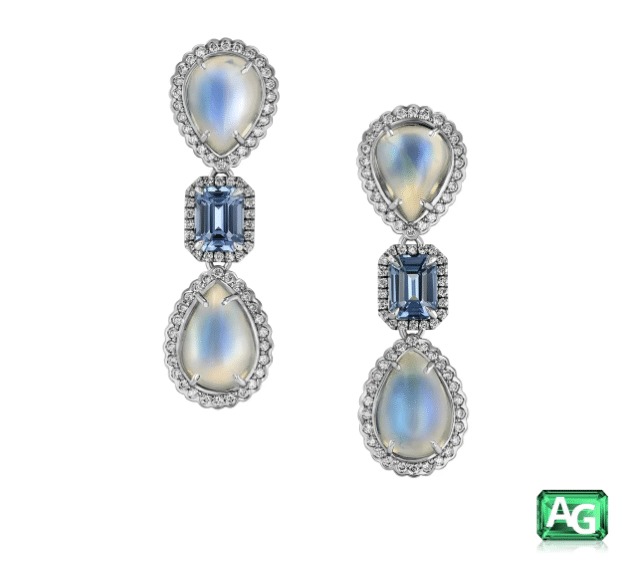
Moonstone
The effect visible on moonstone’s surface is often described as looking like moonlight through clouds—a very apt description!
In fact, “adularescence” is an old name associated with moonstone, and thus the effect has become almost synonymous with that gem.
Moonstone gemstones can have body colors ranging from white to colorless, blue, peach, and brown, while the sheen will most often appear blue but can also appear colorless, yellow, or multi-hued.
Given the gemstone’s luminous appearance, it’s no wonder that many legends surrounding the gem involve the moon.
Many stories speak of how a moonstone’s appearance and powers would wax and wane with the phases of the moon; a full moon was the most powerful and would make the stones the most brilliant, while a new moon made moonstone useless and dull.
Moonstone was especially important in many Hindu myths. They believed that moonstones were the crystallized beams from the moon that fell to Earth and “froze.” They saw the stone as a good luck charm, as well as a wonderful gift for young couples, either right before a wedding or on the wedding day.
Many cultures speak of moonstone’s usefulness as an aid in traveling by night, especially by boat. Moonstone is also said to be a wonderful sleep aid and to guard against insomnia.

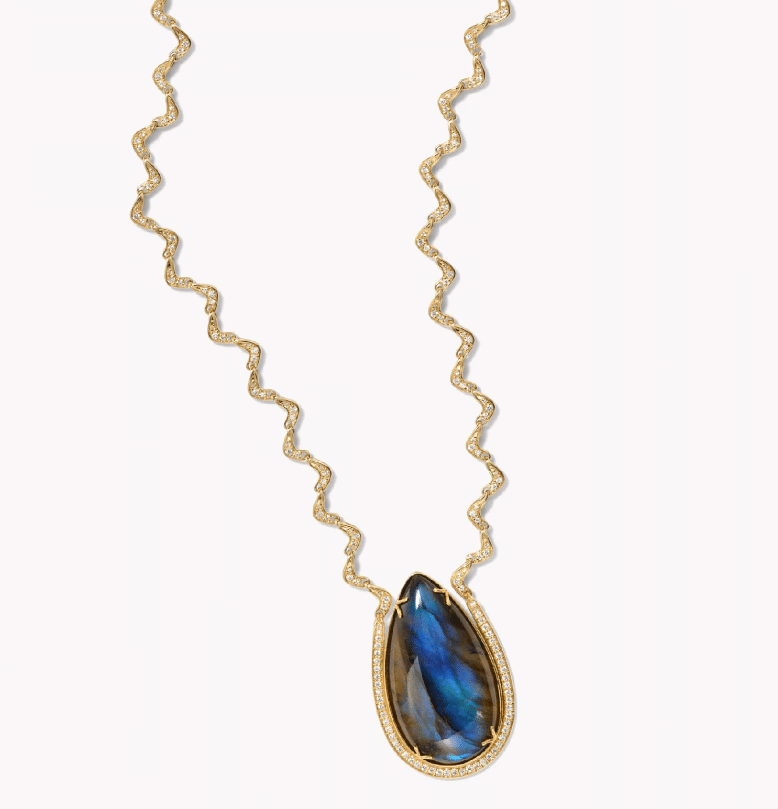
Labradorite
As the name implies, labradorescence is an optical effect seen in labradorite. While it is also caused by light slipping through gaps at the microscopic level, these layers are rough and irregular, and can only appear if certain chemical elements are present in the mineral.
It creates a stunning wash of iridescent colors on the surface of labradorites.
Labradorites can be found in large slabs, which makes them a popular gem for more abstract styles or carved pieces set into jewelry.
The name “labradorite” comes from an early location where the mineral was mined, Labrador, Canada; however, there are records that show this wasn’t the first sighting of the gemstone.
The most well-known myth of labradorite is that of the Inuit people. They believed that labradorite was the frozen rays of the Aurora Borealis, and it’s easy to see why. The story goes that an Inuit warrior found a cave filled with this shimmering gemstone, and he tried to break the stones to free the light trapped within to return it to the heavens.
The gemstone was extremely valuable as a magical talisman and divine guide. To this day, labradorite is associated with magic and mystery and is said to strengthen intuition.
Labradorites can exhibit spectral colors, all at once or one at a time, and can vary widely in body colors and transparency.
The effects of labradorescence and adularescence truly capture an enchanted feel, often appearing so otherworldly they seem to be artificial. But these gemstones, and the scattering of light that makes them popular, are all natural.
Something spectacular from the ordinary. Feldspar, one of the most abundant minerals on Earth, boasts an extraordinary phenomenon.
If you want to include a little magic in your life, consider adding some phenomenal feldspars to your collection.