Understanding your AI tools and their limitations is essential for leveraging them effectively. In this article, we’ll explore how you can use AI to create professional-quality images of your jewelry that rival traditional photoshoots. Our goal: To produce a social-media-worthy image generated entirely through AI.
For this experiment, we selected a distinctive pendant to test across multiple platforms and see what each tool could deliver.
An 8.5–9 MM white cultured freshwater pearl, diamond, and sapphire pendant with chain in 10K white gold.
Midjourney
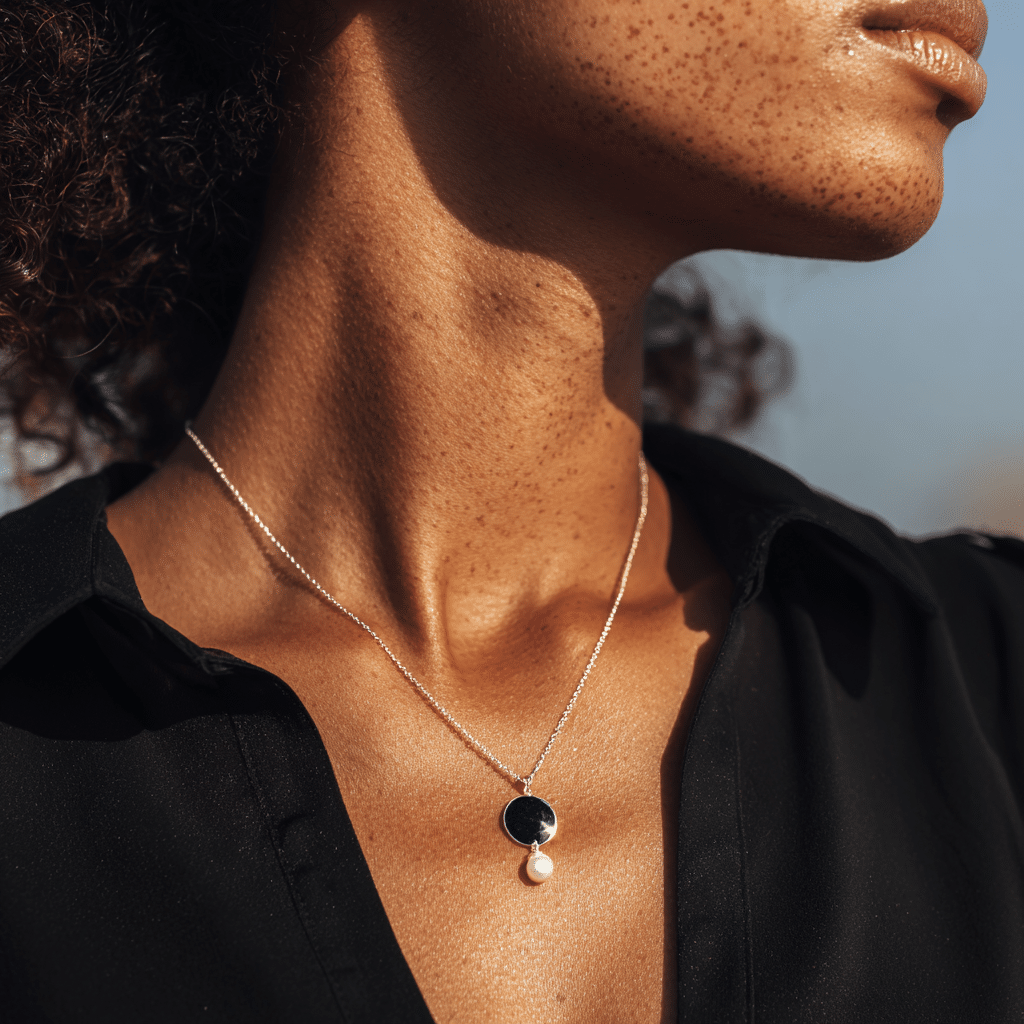
Midjourney is a powerhouse for visual generation, but it has a critical limitation: You can’t ask it to reproduce a specific piece of jewelry with accuracy. While Midjourney excels at generating similar items and sparking inspiration for new designs, it struggles with precise product representation.
In our test, Midjourney produced a stunning image with exceptional composition and lighting. However, when we attempted to incorporate our specific pendant, the AI created variations that only loosely resembled the original piece. The generated pendants shared some design elements but lacked the faithful reproduction we needed for product marketing.
Midjourney image, prompted to represent our pearl pendant.
Best use case: Midjourney shines as a tool for creating lifestyle imagery that aligns with your brand aesthetic and complements your jewelry’s style. It’s perfect for mood boards and creative direction. It’s also a great tool to get visual inspiration for a new piece of jewelry.
Limitation: You can’t currently use Midjourney to produce lifestyle imagery representing your product.
Nano Banana
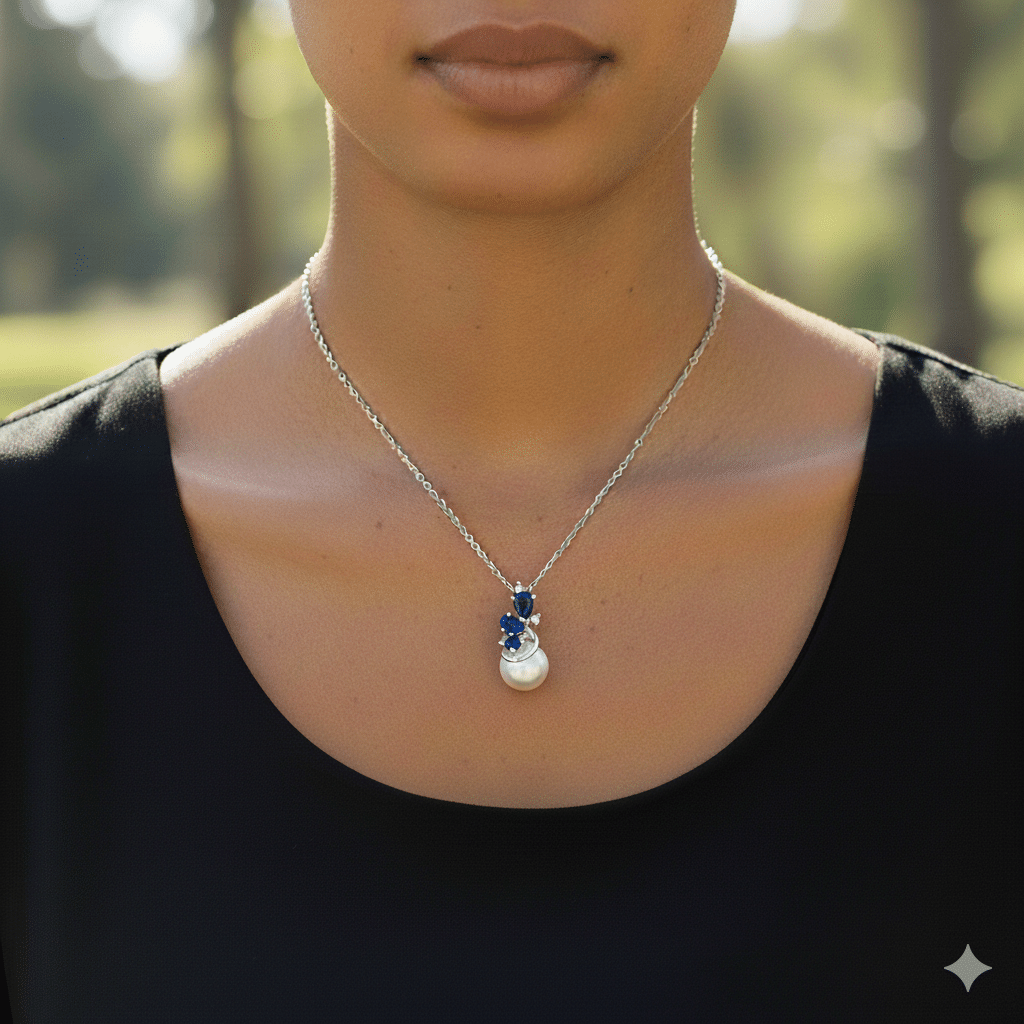
Nano Banana took a different approach, successfully placing an accurate representation of our pendant onto a model. The tool even rendered realistic shadows and dimensional detail, demonstrating its strength in product integration.
However, the results had notable drawbacks. The overall image quality suffered from artificial-looking skin texture and a lack of photorealism that would be immediately apparent to viewers. While the product accuracy was impressive, the surrounding context fell short of professional standards.
Nano Banana image, prompted to represent our pearl pendant.
Best use case: Nano Banana is great to get an accurate representation of your product in a different context. It can also work as a picture editing tool. You could for example prompt it to display a piece of jewelry either larger or smaller.
Limitation: While Nano-Banana is a powerful tool, its output can sometimes look flat and noticeably AI-generated. Additionally, the tool doesn’t always interpret prompts accurately, making it a bit of a gamble to achieve the desired result.
DALL·E (ChatGPT)
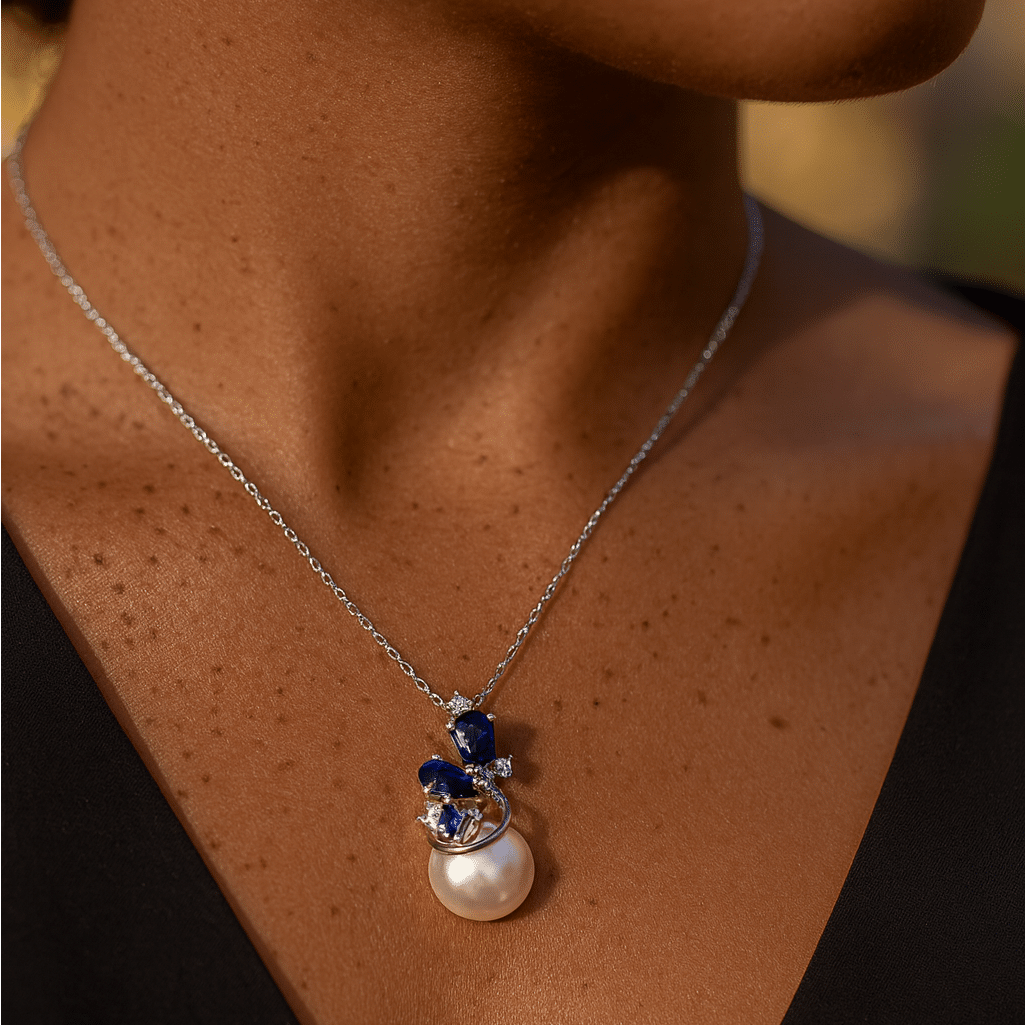
DALL·E produced a somewhat accurate rendering of the pendant, closer than Midjourney but not quite precise enough for commercial use. The skin texture showed improvement over Nano Banana’s attempt, appearing more natural and less obviously AI-generated. However, the overall visual appeal didn’t match Midjourney’s sophisticated composition and aesthetic quality.
The result landed in an uncomfortable middle ground: not accurate enough for product photography, yet not artistic enough to work as aspirational lifestyle content.
DALL·E image, prompted to represent our pearl pendant.
Best use case: DALL·E is highly responsive and interprets prompts with accuracy. It also excels at upscaling images while maintaining overall quality.
Limitation: The resulting visuals can sometimes appear flat and lack precise product details.
The Winning Combination: A Multi-Tool Workflow
Finally, we discovered the sweet spot by combining the strengths of all three platforms. Here’s our process:
Generate the foundation using Midjourney to create a beautifully composed lifestyle image with ideal lighting, model pose, and brand-appropriate aesthetic
Add product accuracy by prompting Nano Banana to integrate our specific pendant onto the model from the Midjourney image
Enhance resolution through DALL·E, upscaling the final composition to 2000×2000 pixels for social media and web use
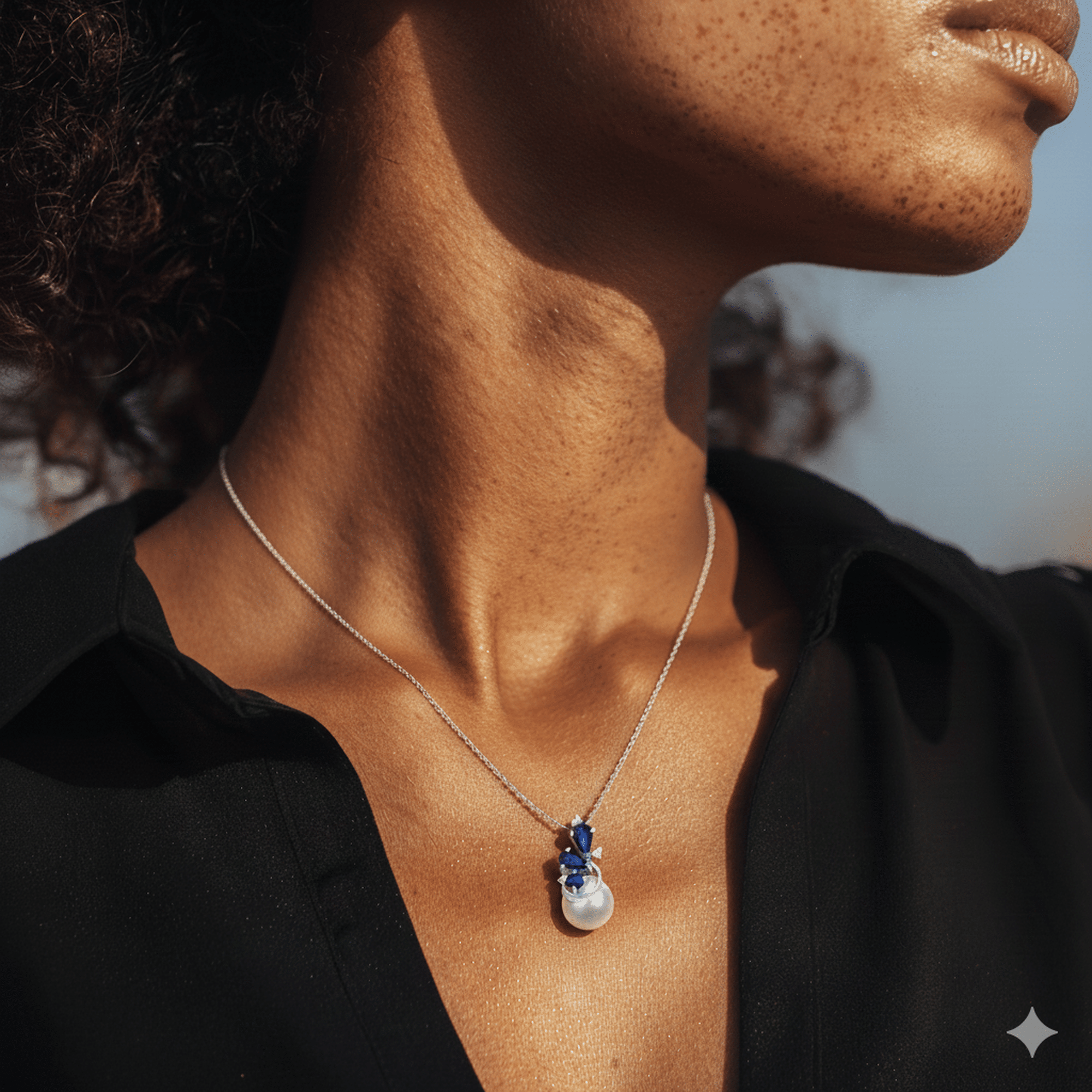
This hybrid approach delivered the best results: Midjourney’s professional composition, Nano Banana’s product accuracy, and DALL·E’s resolution enhancement combined to create a genuinely usable marketing asset.
Generated using Midjourney, Nano Banana, and DALL·E in a multi-step process.
AI is a transformative tool for jewelry marketing, and it’s improving rapidly. However, generating satisfying images still requires multiple iterations, strategic tool selection, and human creative direction. You can’t simply input a prompt and expect perfection. The process demands experimentation and a clear understanding of each platform’s capabilities.
That said, when used thoughtfully, AI can dramatically reduce photography costs while delivering impressive results. As these tools continue to evolve, jewelers who master multi-platform workflows will gain a significant competitive advantage in creating compelling visual content efficiently and affordably. AI won’t replace your creative judgment, but it can amplify your ability to bring visual ideas to life without the logistics and expense of traditional photoshoots.
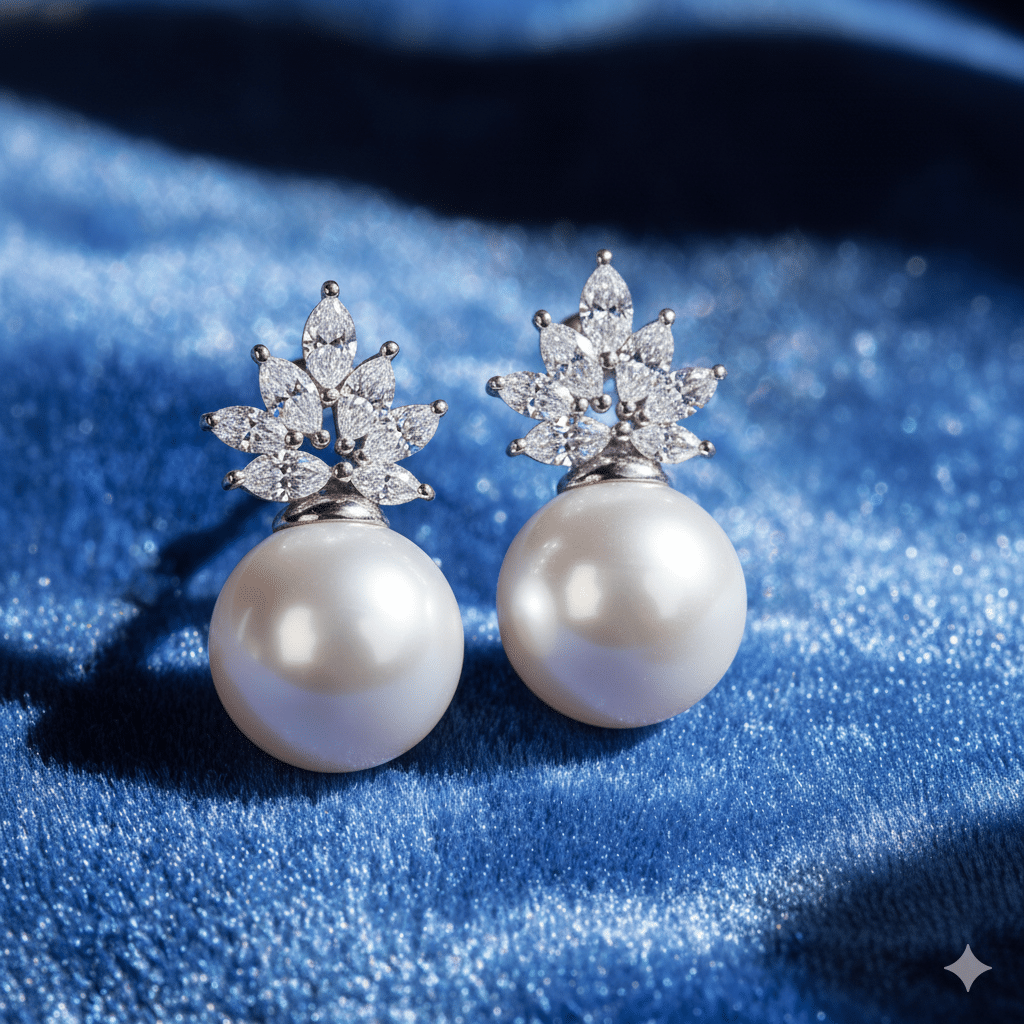
Image generated using an AI multi-step process:11-12mm South Sea cultured pearl and 1-1/2 CT TW diamond cluster earrings in 14K white gold.
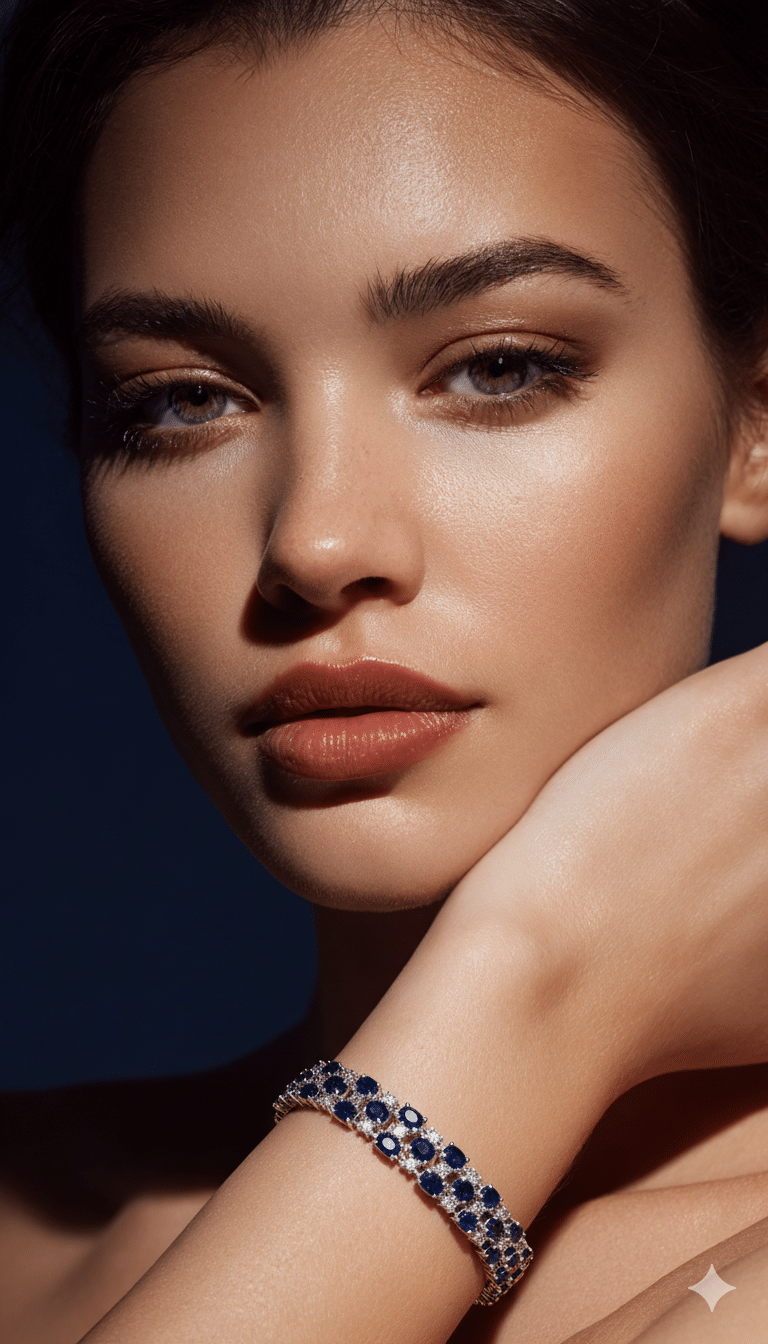
Image generated using an AI multi-step process: 15 3/4 CT TGW blue and white sapphire bracelet in 14K white gold.